How to Take a Taxi or Grab in Bangkok (Like a Local)

Taking a taxi or using Grab in Bangkok is simple once you know what to expect. Most confusion comes from small details like meter rules, pickup spots, traffic, and payment, even though locals do this every day.
This guide shows you exactly how to take a taxi or use Grab in Bangkok, step by step. It is not a citywide transport overview. It is for the moment when you already know you want a car and just want it to work without stress.
If you are still deciding whether to use trains, boats, taxis, or a mix of everything, start with Getting Around Bangkok: Simple Guide for First Time Visitors. That guide helps you choose the right transport for your trip. This one starts after that decision is made.
Below, I walk through how to get a metered taxi, how to use Grab properly, what to watch for, and how to avoid the common issues that frustrate first time visitors. Once you understand these basics, taxis and Grab become one of the easiest ways to move around the city.
TLDR
- Grab is the easiest option for most first-time visitors. Prices are shown upfront and there is no negotiation.
- Metered taxis are cheaper for short trips when the meter is used and traffic is light.
- Always confirm the taxi meter before moving. If a driver refuses, walk away or use Grab.
- Taxis are easiest to find on side streets or at hotels, and hardest directly outside major attractions.
- Use Grab for late nights, longer rides, airport-style trips, or anytime you want the simplest experience.
Before you book a ride
Taxi vs Grab in Bangkok (when to use each)
Taxis and Grab both work well in Bangkok, but they are useful in different situations. Knowing when to use each one makes the rest of the process easier.
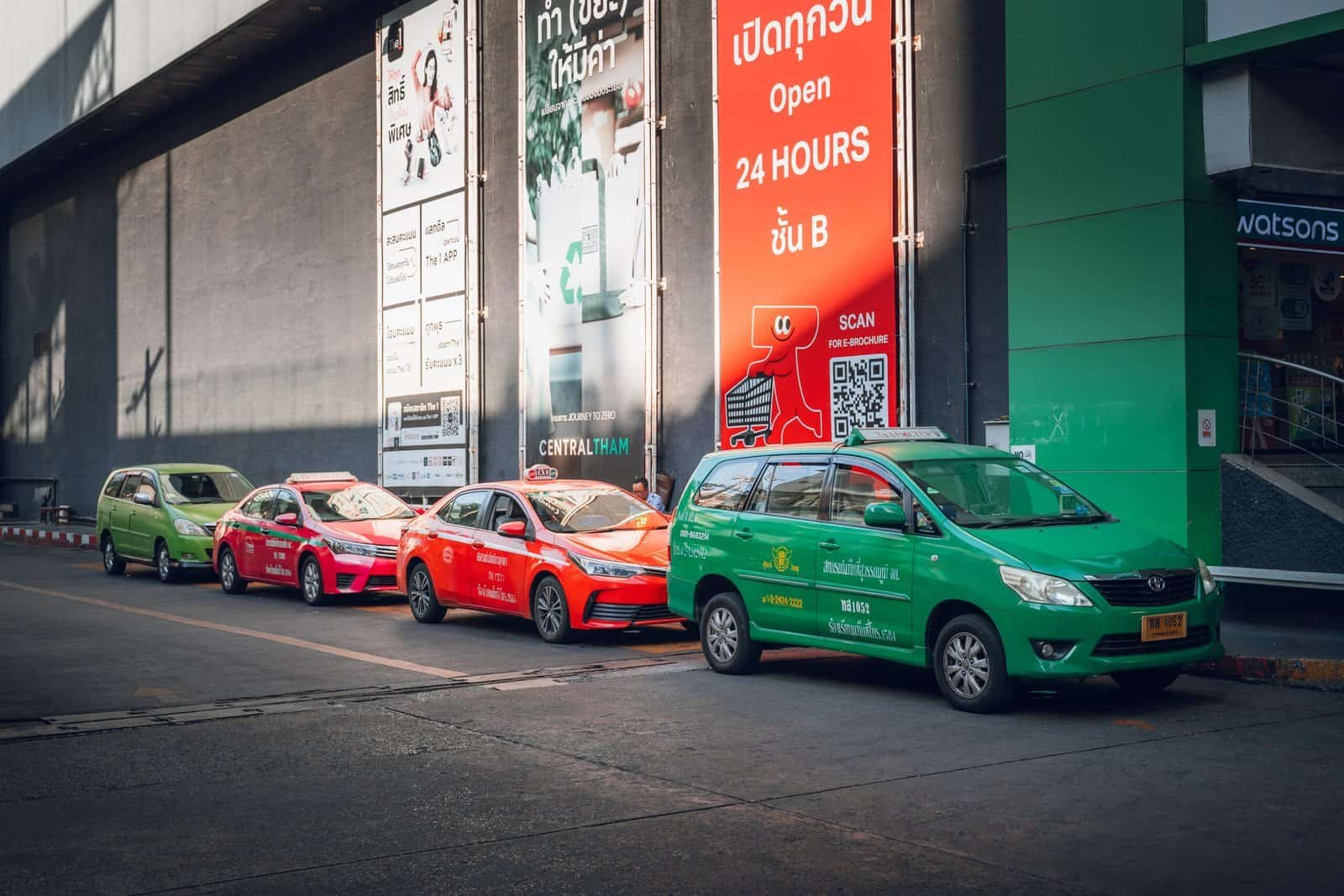
Regular taxis are everywhere. They are cheap when the meter is used and work well for short trips when traffic is light. You will see them constantly, especially on side streets, near hotels, and around malls.
Locals use both taxis and Grab every day. Travelers tend to prefer Grab because it removes language barriers and pricing uncertainty, not because taxis are unsafe or uncommon.
Grab is usually easier for first-time visitors. The price is shown in the app before you confirm, there is no negotiation, and the pickup and destination are logged in English. Grab works best for longer rides, late nights, airport-style trips, or anytime you do not want to think about directions or fares.
Neither option is “better” in every situation. The goal is to choose the one that fits the moment instead of forcing the same option every time.
What you need ready (phone, data, address in Thai, small cash)
A little preparation makes taxis and Grab much smoother.
Make sure your phone has mobile data. You need it to book Grab, watch your route, and communicate with drivers if needed.
If your signal drops, having directions already loaded helps.
Save your hotel name and address in Thai on your phone. Even if the driver does not read English well, showing the Thai address usually solves the problem quickly.
Carry small bills. Many taxis cannot break large notes, and toll roads are paid in cash. Having 20s, 50s, and 100s avoids awkward stops at convenience stores.
Before you leave, take a quick screenshot of your destination or route. Malls, underground garages, and busy areas can interrupt your signal, and having a backup keeps the ride simple.
How to take a metered taxi in Bangkok
How to get a taxi in Bangkok
Taxis are everywhere in Bangkok, but where you try to get one matters more than people expect.
It is usually easiest to find a taxi on a side street, near a hotel entrance, or outside a mall. Drivers in these spots are more likely to accept short trips and use the meter without hesitation.
The highest chance of meter refusal is directly outside major temples and popular attractions. These areas often attract drivers who prefer flat fares, so walking one block away usually solves the problem.
If you are staying at a hotel, ask the staff to flag a taxi for you. This small step removes most issues before they start and is especially helpful if you are heading out during busy hours.
Local tip:
If you want to flag a taxi like locals do, don’t wave your arm above your head. Stand near the curb, hold your arm straight out in front of you or out to the side, and wave your hand up and down. It can look like you’re shooing someone away at first, but that motion is how taxis recognize you’re calling them over.
The one thing to confirm before you move
By law, all licensed taxis in Bangkok are required to use the meter, including taxis at the airport. When it is on, the screen will light up and start counting from the base fare. If the driver starts driving without turning it on, that is your cue to speak up or get out.
You do not need to argue or explain. A simple gesture toward the meter usually works. If the driver refuses, thank them, step out, and look for another taxi. There are always more.
Once the meter is running, the ride is usually straightforward. You pay what the meter shows, plus any tolls used during the trip.
What to do if they refuse the meter
Meter refusal happens, especially in tourist-heavy areas. It is not personal, and it is not worth negotiating.
If a driver insists on a flat fare and you are not comfortable with the price, just decline and leave the car. Do not feel pressured to stay or explain. Walking away is normal and expected.
If you want to avoid this entirely, use Grab or have your hotel arrange a taxi. Both options remove the meter conversation completely.
Paying, tolls, and getting change
At the end of the ride, you pay what the meter shows. Tolls are added separately if the driver uses a toll road, which is common for longer trips or when traffic is heavy.
Tolls are paid by the passenger and are normal. Drivers will usually ask before entering a toll road, but sometimes they will just go ahead if it clearly saves time.
Most taxis accept cash only. This is why small bills matter. If you only have a large note, the driver may need to stop to make change, which slows things down.
Receipts are not automatic, but you can ask if you need one.
Common taxi problems (and quick fixes)
Sometimes the driver does not know the exact location, even if the area is familiar. Showing the destination on your phone or pointing to a nearby landmark usually helps.
If the route feels longer than expected, open Google Maps and follow along quietly. Drivers may take different roads to avoid traffic, which can look confusing if you are not familiar with the area.
If communication feels difficult or the situation feels uncomfortable, it is okay to end the ride early and switch to Grab. You are not locked into any one option.
Once you get a metered taxi successfully, most of the stress disappears. The problems tend to happen before the ride starts, not during it.
How to use Grab in Bangkok
Setting up grab (account, payment, location)
Grab works very similarly to Uber and is the main ride-hailing app used in Bangkok. If you have used Uber before, Grab will feel familiar.
Download the Grab app and create an account before you need a ride. Set up your payment method ahead of time so you are not rushing while standing on a busy street. Grab accepts both cash and cards in Bangkok, but card payments are usually smoother.
Make sure location services are turned on for the app. Grab relies heavily on accurate pickup pins, and weak location settings are one of the main reasons rides get delayed or canceled.
If you are using mobile data, open the app while you still have a good signal. Underground malls, parking garages, and hotel driveways can sometimes interfere with GPS.
Bolt also operates in Bangkok, but reliability can vary. It is also cash-only, which is why most first-time visitors stick with Grab.
Booking a ride step-by-step
Booking a Grab is straightforward once you know the flow.
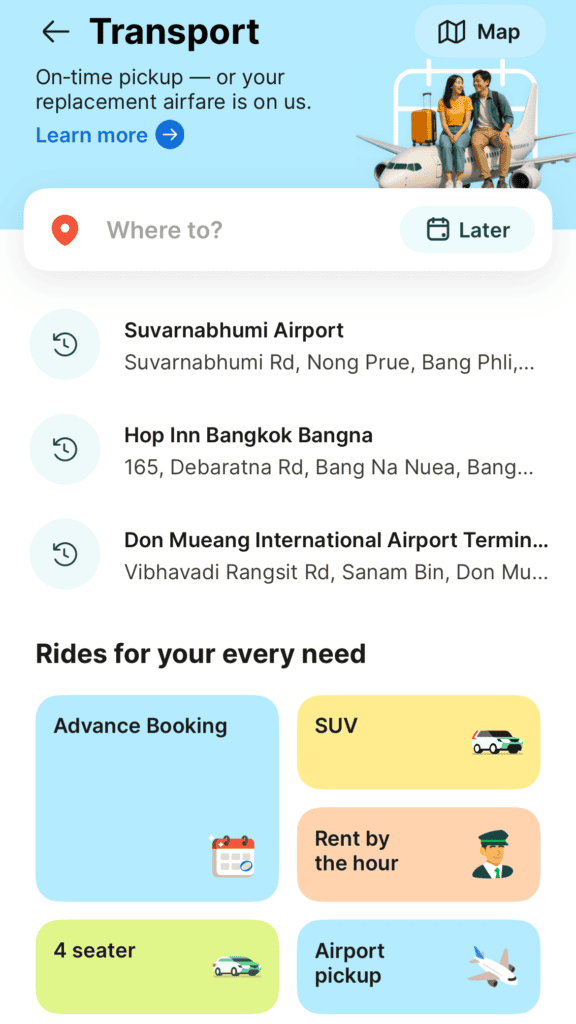
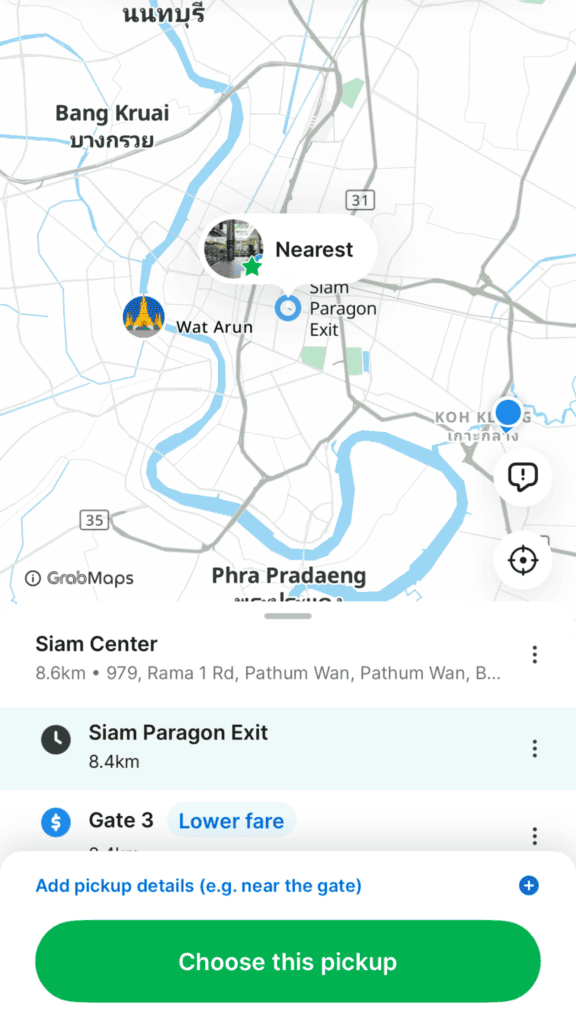
Open the app and enter your pickup location. Double-check that the pin is correct. This matters more than the address name, especially in busy areas.
Next, enter your destination. The app will show you the route and the price before you confirm. This is one of the biggest advantages of Grab. You know the cost upfront.
Choose your ride type, confirm the booking, and wait for a driver to accept. Once matched, you will see the car details, driver name, and estimated arrival time.
When the car arrives, check the license plate before getting in. This quick habit avoids awkward moments, especially in crowded pickup zones.
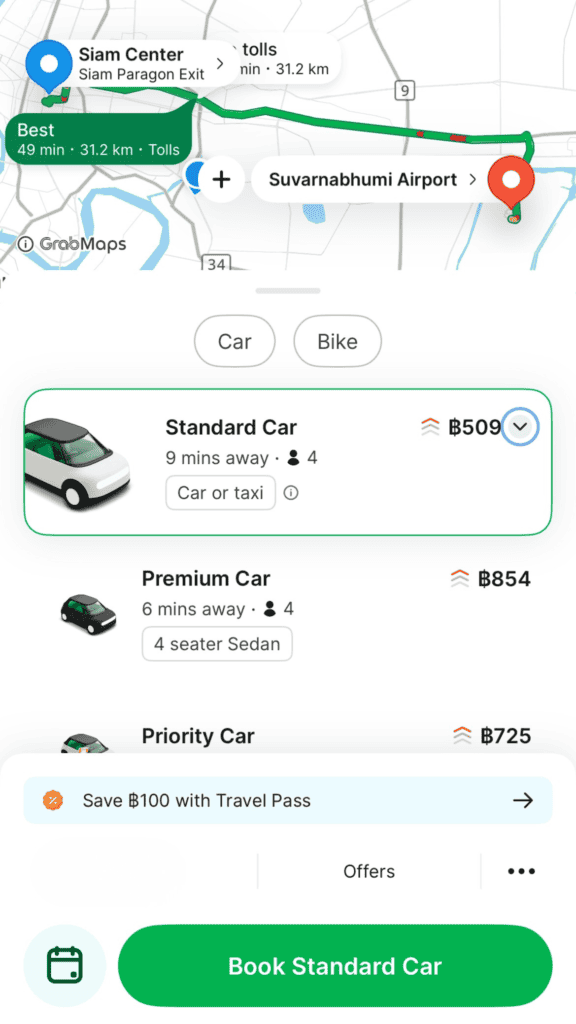
Picking the right ride type (GrabCar, GrabTaxi, XL)
GrabCar is the default choice for most travelers. It offers private cars with upfront pricing and works well for nearly all situations.
GrabTaxi connects you with a licensed taxi booked through the app. Pricing can vary slightly, and availability depends on the area, so most visitors stick with GrabCar unless they are already comfortable using taxis.
If you are traveling with multiple people or large luggage, choose a larger vehicle option. This avoids cramped rides and last-minute cancellations.
If you are unsure which option to pick, GrabCar is the safest choice.
Pickup tips at malls, hotels, and busy streets
Pickup location is where most Grab frustration happens, not the ride itself.
At malls, look for designated ride-hailing pickup zones. These are often clearly signed but may be on a different level than the main entrance. Security guards or mall staff can point you in the right direction.
At hotels, wait in the designated pickup area or driveway instead of the sidewalk. This helps drivers find you faster and avoids traffic issues.
On busy streets, walk a short distance away from main intersections. Even moving half a block can make pickups smoother and faster.
If the driver messages you, respond briefly and clearly. Simple replies work best.
Surge pricing and when to wait it out
Grab prices can increase during heavy traffic, rain, rush hour, or large events. This is normal and temporary.
If the price looks high and you are not in a hurry, wait five to ten minutes and check again. Prices often drop once demand eases.
If you are tired, carrying bags, or traveling late at night, paying a little extra can be worth it for the convenience. Grab still removes the uncertainty that comes with negotiating taxi fares during busy times.
Common Grab issues (and quick fixes)
Drivers sometimes cancel rides, especially during peak hours. If this happens, just rebook. It is annoying, but common, and usually resolves within a few tries.
If the driver cannot find you, send a short message or move slightly to match the pickup pin. Avoid long explanations.
If the app freezes or glitches, close it and reopen. Grab is generally reliable, but crowded areas can strain the system.
Once you get used to booking and pickups, Grab becomes one of the easiest ways to move around Bangkok.
Private airport transfer (optional alternative)
If you prefer everything arranged in advance, a private transfer can be a low-stress option. Welcome Pickups offers pre-booked airport pickups with a fixed price, an English-speaking driver, and meet-and-greet service inside the terminal.
This can be helpful if you are arriving late at night, traveling with family, or carrying a lot of luggage and just want to get to your hotel without navigating pickup areas or traffic decisions. It is not required for most trips, but it is a simple alternative if you value predictability over flexibility.
Safety and comfort tips
Solo travelers and late nights
Bangkok is generally safe, and taxis and Grab are widely used at all hours. Most issues come from confusion, not danger.
If you are traveling alone or heading out late, Grab is usually the easiest option. Your ride details are logged in the app, the route is visible, and there is less chance of miscommunication. This alone makes many people feel more comfortable at night.
Stick to well-lit pickup spots and main roads when possible. If something feels off before the ride starts, you can always cancel and book again. You are never obligated to stay in a car that makes you uncomfortable.
Sharing your live location with a friend or partner is an easy extra layer of reassurance, especially on longer rides.
Luggage and longer rides
If you have luggage, taxis and Grab are much more comfortable than squeezing onto trains. The key is choosing the right moment and the right vehicle.
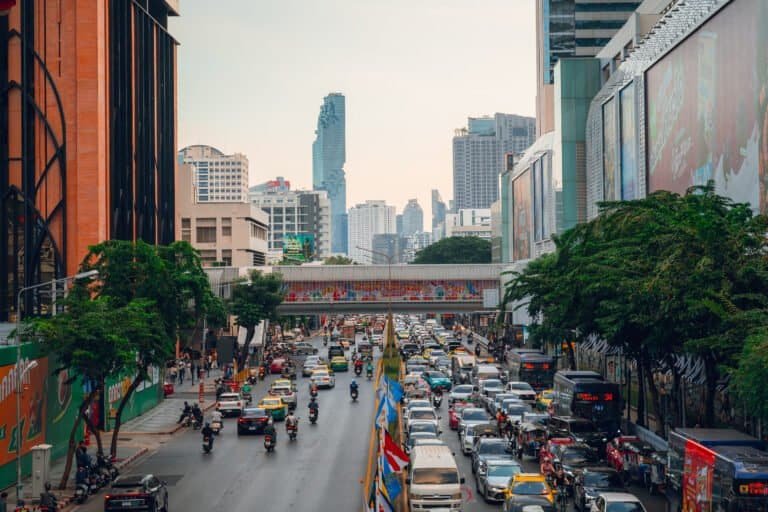
Avoid peak rush hours if you can. Traffic between 7 and 9 in the morning and 5 and 7 in the evening can turn short trips into slow ones, especially with bags.
With Grab, select a larger vehicle if you have more than one suitcase. This prevents last-minute cancellations and makes the ride smoother for both you and the driver.
For longer cross-city rides, Grab is often less stressful than a street taxi because the route and price are set upfront. You can relax instead of watching the meter in traffic.
Comfort matters. If you are tired, overheated, or carrying bags, choosing the simpler option usually leads to a better day overall.
Quick cheat sheet
If you want the easiest option
Use Grab.
Upfront pricing, no negotiation, clear pickup and drop-off. This is the simplest choice for first-time visitors, late nights, or long rides.
If you want the cheapest option
Use a metered taxi.
When the meter is on and traffic is light, taxis are usually cheaper than Grab for short trips.
If you’re in a tourist zone
Walk a short distance away or use Grab.
Taxis directly outside temples and major attractions often refuse the meter. Moving one block or booking through the app avoids this.
If it’s raining or rush hour
Use Grab, expect delays.
Traffic will be slow no matter what. Grab removes the extra friction of negotiating while everything is busy and chaotic.
Taxi and Grab FAQ
Is there Uber in Thailand?
No. Uber no longer operates in Thailand. Grab is the main ride-hailing app used in Bangkok.
Do taxis in Bangkok always use the meter?
They are required to, but some drivers refuse in tourist areas. If the meter is not used, you can decline the ride and find another taxi or use Grab.
Is Grab safe to use in Bangkok?
Yes. Grab is widely used by locals and travelers. Ride details are tracked in the app, and prices are shown before you confirm.
Do I need to tip taxi or Grab drivers in Bangkok?
Tipping is not expected. Many people round up the fare or add a small amount if the driver helps with luggage, but it is optional.
Can taxi and Grab drivers speak English?
Some do, many do not. Showing your destination on your phone or in Thai usually solves any communication issues.
Can I pay cash for taxis and Grab?
Yes. Most taxis accept cash only. Grab accepts both cash and card, depending on how you set it up in the app.
Final thoughts
Taxis and Grab are part of everyday life in Bangkok, and once you know what to expect, they are easy to use. You do not need to overthink it. Use Grab when you want simplicity or are tired. Use a metered taxi when it is convenient and the meter is on.
If something does not feel right, you can always switch options. There are plenty of taxis on the road, and Grab is only a few taps away. Once you find your rhythm, getting around by car becomes just another simple part of your day in the city.